|
A 13-day journey offering an amazing and
comprehensive view of South Africa, incorporating
virtually every internationally-regarded 'must see'
sight and highlight.
As the train travels the length and breadth of
the country, guests can enjoy the great variety
of landscapes, shorelines, cultures, lifestyles
and cuisine that the South African Rainbow
Nation has to offer. There are many varied
options included within this tour, so please
contact us for a full itinerary.
The start point is Cape Town, with tours of the
interesting sites of this fabulous city. From
here the train will then traverse through the
country to the vineyard region of Overburg with
its history of Hugenots, and fabulous Cape Dutch
houses.
Passing whaling stations and the coast, we
continue to Kimberley, the home of the De Beers
diamond mines, and so on to Bloemfontein. After
a tour around this interesting town, we rejoin
the train to travel overnight to Ladysmith.
The train now heads to the eastern jagged peaks
of the Drakensberg, following waterways as they
drop and cascade down mountain clefts, through
hidden valleys to the tumbling luscious hills
that extend through the Midlands. Here there are
visits to Boer war battlefields, lush forests,
and a shopping experience of an eclectic and
fascinating mix of arts and crafts as well as
world-class restaurants.
Overnight travel takes guests to Durban, to
experience the vibrance of South Africa's third
largest city. Its beautiful long beaches are
enhanced by the sub-tropical climate. Hindu,
Sufi and Muslim temples provide a mix of
interests. You will see the Juma Musjid, the
largest mosque in South Africa, whose twin
minarets are a striking city feature, as well as
the most opulent Hindu structure.
Whilst the train travels to Zululand, guests
have time to study the life of the Zulu warrior
before visiting a Zulu cultural village. Our
train carries on to the tiny kingdom of
Swaziland, where off-board excursions include a
visit to Manzini where guests experience the
Swazi market, a hive of activity displaying a
wide variety of skillfully crafted woodcarvings,
colourful textiles and superb basketwork, for
which Swazis are renowned. There are trips to
museums, glass works, and a drive through the
Komati River Valley with its panoramic views.
By day 11 the train arrives at Kruger National
Park, where one can either visit the park or
take one of the many options available: visit a
gold mining area, hot air balloon flight,
safari, to name a few.
The penultimate day sees guests visiting many
sites in Pretoria, Johannesburg and Soweto,
before bidding farewell to their journey on the
Shongololo Express.
Railways
of Africa
Shongololo Express train safaris traverse
eight countries in Africa on four different routes
through South Africa, Namibia, Botswana, Mozambique,
Zimbabwe, Zambia, Swaziland and Tanzania.
Passengers on board the train travel comfortably
during the night, waking up each morning at a new
destination. Shongololo Express train safaris are a
unique concept and operate like a “cruise ship on
land”; there is no daily packing or unpacking of
luggage required. During the day guests are taken on
a variety of excursions by professional
multi-lingual guides (French, German, English and
Afrikaans), on air-conditioned Mercedes Benz
Sprinter buses that are carried on board the train.
The tour itinerary changes daily, with a variety of
excursions from which guests can choose and which
fall into the categories of Highlights, Wildlife &
Eco Tourism, Culture and History. All excursions,
including the guides, entrance fees and transport
are included in the tour price. In addition, there
are many optional extra activities on offer such as
game drives on open air vehicles, elephant back
riding, hot air ballooning and break away overnights
in private game lodges.
The tour price also includes a full English &
continental breakfast and a four course dinner. The
evening set menus include many elements of the
African cuisine of the countries which we visit. The
only items not included in our tariffs are clients’
lunches, drinks, laundry, gratuities, optional
extras, break away options and other expenses of a
personal nature.
Shongololo Express has been in operation for fifteen
years and continues to provide its guests with a
warm welcome and friendly atmosphere on board the
train. Our guests, many of whom come back again and
again, make new friends and take away life time
memories from their grand African adventures.
 Franco
- Ethiopian Railway from Addis Ababa to
Djibouti on the Horn of Africa Franco
- Ethiopian Railway from Addis Ababa to
Djibouti on the Horn of Africa
by
Jerry W. Bird
Given Aladdin's 3
wishes I would: (1) Restore Emperor Haile
Sellasie's original 'Lion of Judah'
railway engine that's standing all alone
in the train yard. (2) Hook it up to the
Emperor's prized set of antique French and
British crafted coaches, and (3) Operate a
twice daily luxury tour on the
Franco-Ethiopian Railway. Built in the
1930s, the 482 mile line stretches from
Ethiopia's capital, Addis Ababa, via
Nazaret, Rift Valley and Dire Dawa, to
Djibouti, a French protectorate on the
Gulf of Aden. In a 10 -minute BBC
interview at the Gare (Railway Station) I
commented, "Think of the much needed
income such a packaged tour would generate
for the Ethiopian economy.
Continued
 Blue
Train with White Glove
Service Blue
Train with White Glove
Service
by
Muguette
M. Goufrani
While
in Johannesburg this spring with
Minah Makhoto
and Queen Mokgopo of
ATA's Gauteng
Chapter,
we had the opportunity of visiting the
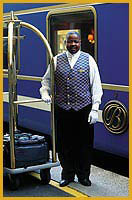
main railway station and Blue Train's
impressive head office facilities. During
this important meeting, our editors were
given a thorough update on the company's
newest programs and facilities. I have
always considered the Blue Train a
lifetime experience . . . land cruising
across South Africa. Plans are being made
this summer for
 a
special series of rail tours organized by
our magazine and participating ATA
chapters. Watch for
news! For years
I had read that South Africa held many
pleasures for those of an adventurous
spirit or romantic nature. So one summer,
taking a month's vacation from my job as a
travel agent in Ivory Coast, West Africa,
I headed south. Here at last was my chance
to spend some leisurely, laid back weeks
getting to know that fascinating country
surrounding the Cape. While the sights and
delights were many and varied, the epitome
was my experience aboard the famous Blue
Train. It was like the finest luxury
cruise, sailing across a sea of
ever-changing landscapes . Yet there was
time and space to savor every waking
moment.(photos to come) I managed to read
some pamphlets about the line's history,
which spans over 50 years. Back in 1928,
it became the first luxury train in South
Africa.
Continued a
special series of rail tours organized by
our magazine and participating ATA
chapters. Watch for
news! For years
I had read that South Africa held many
pleasures for those of an adventurous
spirit or romantic nature. So one summer,
taking a month's vacation from my job as a
travel agent in Ivory Coast, West Africa,
I headed south. Here at last was my chance
to spend some leisurely, laid back weeks
getting to know that fascinating country
surrounding the Cape. While the sights and
delights were many and varied, the epitome
was my experience aboard the famous Blue
Train. It was like the finest luxury
cruise, sailing across a sea of
ever-changing landscapes . Yet there was
time and space to savor every waking
moment.(photos to come) I managed to read
some pamphlets about the line's history,
which spans over 50 years. Back in 1928,
it became the first luxury train in South
Africa.
Continued
Cape
Town to Pretoria on Rovos Rail, Pride of
Africa
by Jerry W.
Bird
"The
design of the train has given us suites
considerably larger than the world's
famous trains such as the Orient Express,
the Blue Train, Royal Scotsman in England
and El Andalus in Spain." Rohan
Vos
 One
of the first lessons one learns on
entering the wonderful world of Rovos Rail
is that this "travel opportunity of a
lifetime" is not just a South African
experience -- its routes extend to five
other countries on a network of steel
rails. For example, there's an annual
excursion to Dar es Salaam, Tanzania,
which many rave about. On this cool
January morning, however, the destination
is Pretoria, South Africa's capital city
and headquarters of Rovos Rail, the Pride
of Africa. Our leisurely two and a half
day trip north through the country's
heartland, allows ample time to relax, lay
back, sip the wine, smell the roses, think
lofty thoughts and get to know some
interesting people. Daniel Dunn, one of
the Western Cape's best informed tour
guides, drove us to the Cape Town station,
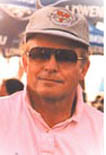
where Rovos Rail's owner
Rohan
Vos
(right) and Sales Manager David Patrick
greeted us, as our baggage was whisked
away in a flash One
of the first lessons one learns on
entering the wonderful world of Rovos Rail
is that this "travel opportunity of a
lifetime" is not just a South African
experience -- its routes extend to five
other countries on a network of steel
rails. For example, there's an annual
excursion to Dar es Salaam, Tanzania,
which many rave about. On this cool
January morning, however, the destination
is Pretoria, South Africa's capital city
and headquarters of Rovos Rail, the Pride
of Africa. Our leisurely two and a half
day trip north through the country's
heartland, allows ample time to relax, lay
back, sip the wine, smell the roses, think
lofty thoughts and get to know some
interesting people. Daniel Dunn, one of
the Western Cape's best informed tour
guides, drove us to the Cape Town station,
where Rovos Rail's owner
Rohan
Vos
(right) and Sales Manager David Patrick
greeted us, as our baggage was whisked
away in a flash
What a way to
celebrate the New Year! As we joined
the other passengers assembled on the
red-carpeted platform, a traditional toast
of South African champagne and orange
juice set the mood, while a trio of
violinists provided soft, soothing
classical music -- a fitting background
for such a memorable send off. At the
microphone Mr. Vos gave a hearty and
humorous "bon voyage," announcing each
guest's name in turn as we boarded the
train. Many nations were represented that
morning - the UK, Norway, Italy,
Australia, USA, Switzerland, Spain,
Germany, France, South Africa and Canada.
These vintage coaches have carried royalty
on past tours, and we soon discovered
there was a European countess among us,
which reflects the company's claim "the
most luxurious train in the world. A mild
thunderstorm was brewing above Table
Mountain, and as rain began to beat on the
windows, the train pulled away from Cape
Town station. Have no fear, I had a
feeling that the trip would be even more
enjoyable, looking out from our cozy
cocoon on wheels. My intuition proved to
be quite true.
continued
Discovering
Casablanca
by
Jerry W. Bird
As
originator of a travel series
called
Railways
of the World,
going to
Casablanca, Morocco's largest city, by
rail was a wonderful way to start off the
week and celebrate the new year. We
enjoyed the journey so completely that the
route from Marrakech (3 hours) seemed far
too short. However, as we soon learned
from the staff on board, visitors can
travel between many of Morocco's principal
cities by rail. That includes the Northern
port of Tangier, a few miles from Spain
with its famous Talgo Train
service.
We were on our way to visit Benachir Akli
of Olive Branch tours who worked with ATA
on the last two great events hosted by
Morocco National tourism
Board.
As
our friend will agree, Rail Travel is
still one of the most practical,
inexpensive and relaxing of all modes
on
transportation, and this route to
Casablanca was a shining example of price
plus convenience. We traveled in a modern,
first class coach, enjoying the privacy of
a 6-seat compartment all to ourselves,
with ample overhead storage for luggage
and carry-ons. The one way tickets
purchased at the counter without
reservations were less than $15 in U.S.
currency.
A simple lunch was
served on board, and the price was
nominal. I settled back in the sofa-like
seating determined to savor every moment
and take in the scenery like a passing
parade, which is exactly what it was. The
views were varied and unforgettable, from
scenes of shepherds and flocks that seemed
right out of the bible's Old Testament, to
multi-layered desert vistas, lush grassy
plains in the foothills country and modern
city scapes as we approached our
destination. Cattle, sheep and camels
grazing side by side was quite different
than your typical pastoral scene. Both the
Marrakech and Casablanca terminals are
clean, well maintained and convenient to
taxis and other transportation from the
heart of the city (this keeps the stress
level low and the pleasure scale high). We
were in and out of the railway terminal
and on our way by Petite Taxi to the
Residence Casablanca Apart'Hotel within a
very few minutes of arrival. Quite a
change from the average plane trip, where
it would takes us that long just to reach
the arrivals area to retrieve our luggage.
Above photo:
Friendly staff to greet you at the
Casablanca Appart'Hotel. continued
Jerry W. Bird is President of ATA
Canada Chapter, Editor and Publisher of
Africa Travel Magazine, and Webmaster for
the ATA site www.africa-ata.org. He is
also Publisher of Air Highways Magazine,
the Journal of Open Skies, featuring
aviation, tourism, transportation and
business worldwide. His career began with
the Edmonton Journal Daily Newspaper, and
expanded into the full spectrum of media -
radio, television, magazines and Internet.
He has won international awards for
creativity in audio visual and print
production.
|








 ..
..